
Why the Best Playgrounds Work More Like Ecosystems


As kids in the Philly area head back to school, we can't help but think about education and landscapes. We’ve previously written about outdoor classrooms that support a more traditional model of learning for K–12 students. But there’s another type of outdoor learning that’s no less valuable: the learning that happens on the playground. Playgrounds are where kids develop cooperation and conflict-resolution skills, improve coordination, build their imaginations, and build stronger, healthier bodies
There are a lot of ways to design a playground. We’ve always been partial to nature play: spaces that recreate—as closely as possible—the experience and benefits of playing in a real natural landscape.
Building an Ecosystem, Not a Playground

Our playground for The Philadelphia School (TPS) began with the client requesting “all wood and really natural-looking” equipment. That’s a terrific start, but wood or wood-like surfaces alone doesn’t create nature play. What makes it nature play is the way all the pieces—trees, plants, soil, stone, water, kids—come together to form an ecological system rather than a collection of disparate "play" objects.
At TPS, we were designing for city kids whose daily landscape is concrete, steel, and traffic. So our goal wasn’t just to make recess nicer; it was to give them a new daily landscape, a little forest hideaway they could call their own. Inspired by nearby Wissahickon Park, TPS’s ecosystem uses play structures that evoke tree trunks and canopies, rocks that kids can scramble over, and water elements that encourage them to experiment with creating dams and rivers. New trees and plants were selected for quick growth, durability, and color. Persimmons and other edible plants invite kids to safely forage and learn about natural food sources.
It’s a place where kids can climb, dam, jump, listen, taste, watch things bloom and die back, and understand the changes in season through their own lived experience.
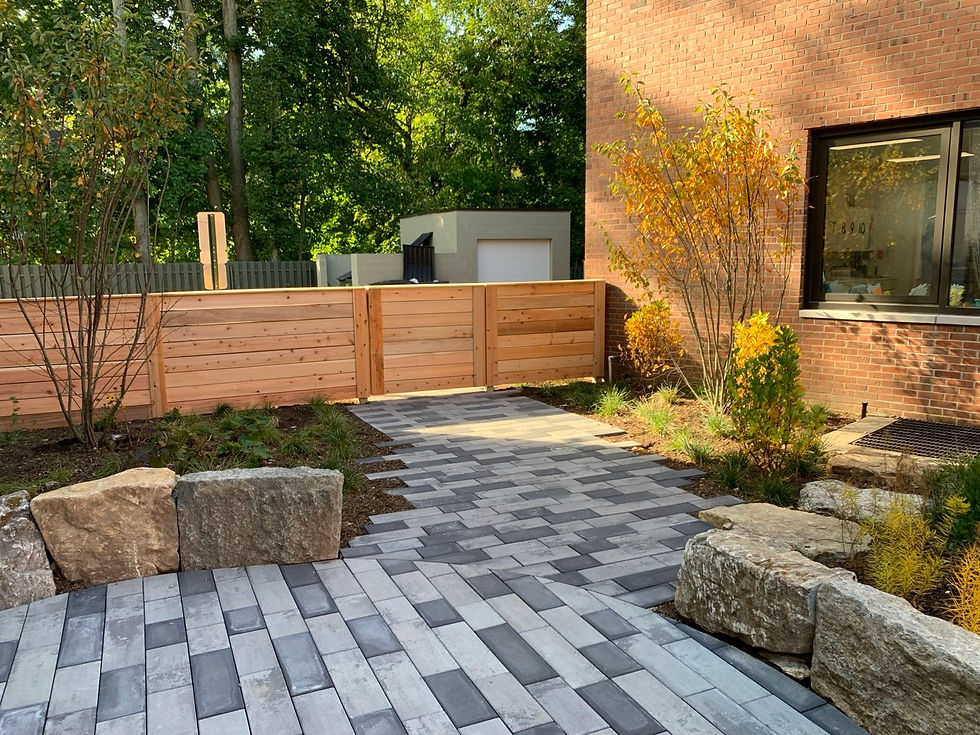
At Montclair Kimberley Academy, durable, quick-to-establish plants will flow over the hardscape to create a more immersive landscape. Dwarf inkberries and amsonia add year-round interest, while serviceberry trees bring color and flavor in warmer months.
Let Kids Decide How to Play

Over the last 30 years or so, playgrounds have been defined by steel and plastic structures that are fully tested, fully insured, and fully prescriptive. They dictate specific uses—essentially telling kids how to play. Natural playgrounds present possibilities, not prescriptions. There are still slides, forts, and climbing structures alongside the sticks and stones, but everything encourages children to explore the environment on their own terms. This kind of play fosters creativity and problem-solving while addressing developmental needs at all ages.
When we do use play equipment, we make sure it meets a wide range of ability and motor skills but also allows for adaptability. Our design for TPS and Kid's Mountain at Lion's Pride Park—a public park, not a school—offers easy stuff, hard stuff, and easy stuff that can become hard as students grow. Preschoolers experiment and move in new ways. Grade-school kids create systems, rules, and relationships. Movable ropes, logs, and stones let them make spaces of their own. A log can be a chair, a balance beam, a building, or part of an enchanted kingdom.
The point isn’t to design every activity. It’s to create enough structure for kids to invent their own.
Encourage Healthy Risk

Prescriptive plastic playgrounds exist, ostensibly, because they’re safer. We grown-ups want to eliminate danger and uncertainty to protect our kids. It's only natural.
But a little risk—an appropriate risk—is essential to play. I don’t mean danger. I mean the kind of uncertainty that lets children test themselves and discover their own limits. In real landscapes, the ground is uneven, things move, and weather changes. Nature play should honor that.
We believe children make choices that matter: where to step, what to lift, how high to climb, when to back off. That’s how judgment, confidence, and resilience are built. We can and should design clear safety boundaries, but inside those boundaries, children need room to fail a little, adapt, and negotiate with each other and with the environment itself.
Our playgrounds at Abington Friends School and Montclair Kimberley Academy are different in scale and ambition, but both use locally harvested rocks and boulders to create places for leaping, jumping, and hiding. At Lions Pride, we worked very hard to make a tall woodland tower and slide fully accessible and code‑compliant, while still preserving the thrill of climbing up into the trees and seeing the park from a new height. In each case, the landscape says: you decide how far you want to go.
A successful nature-play space is one where adults are comfortable enough to step back and watch kids take the lead—physically, socially, and imaginatively.
Natural Playgrounds Work Because They're Unfinished
Kids judge a playground by what it lets them do and discover. Natural playgrounds give children a framework, then leave plenty of room for invention. They’re closer to how kids move through the real world, with challenges that build critical skills.
You can see the difference in the way kids play. They stay longer, invent new games, test ideas, argue a little, solve it, and move on. Creativity, cooperation, and problem-solving emerge directly from the structure of the place. Nature play improves mind, body, and environmental stewardship.
Instead of asking what equipment to buy for a playground, ask what kind of ecosystem you can create for children. How do you want them to experience the world?


