
Landscapes Designed for Mental Health Can Start With a Walk

May is Mental Health Awareness Month and a good reminder that mental and physical health aren’t separate systems — they’re intertwined in a complex relationship, shaped by biology and psychology, but also by the social and environmental conditions around us. If well-being is partly an environmental condition, then parks, trails, gardens, and public spaces aren’t just ecological infrastructure, they’re also public health infrastructure.
The sights, scents, and sounds of nature have their own healing effects. But one of the most powerful benefits of being outdoors is simpler: it gets you moving. Physical activity reduces stress, lifts mood, improves sleep, and creates opportunities for social connection—seeing a neighbor, sharing a path, feeling like you belong somewhere.
The Medical Mile and Preventative Healthcare
Healthcare is starting to catch up to that reality. There’s a growing shift toward prescribing nature and movement as part of treatment. Programs like Prescribe Outside in Philadelphia partner with healthcare providers and community groups to help families spend time outdoors as a preventive and supportive practice.
That’s where the idea of a medical mile comes in.
A medical mile is a clearly marked walking route—often in or near a healthcare district, park system, or neighborhood loop—designed to make prescribed movement simple, measurable, and accessible. Instead of vague advice like “walk more,” a doctor or healthcare provider can recommend something concrete: walk a specific distance, a specific number of days per week. The medical mile makes this doable without a gym membership, fitness tracker, or even a phone. All you need is a path.
How to Implement the Medical Mile
In our trail and park work, we’ll often specify simple distance markers to support this kind of walking medicine. They don’t need to be complicated — numbers painted on pavement or minimal wayfinding elements can suffice. A little goes a long way, and makes it easy to integrate into almost any green space at almost any scale.

On the smallest end, we added a medical mile to our Triangle Park project. This neighborhood park in Rutledge, PA isn’t big enough for a full internal loop, so we extended the route into the surrounding streets with simple painted distance markers. The client loved the idea because it supported every goal they had for the park: strengthen connection, improve health, and expand access to the park’s benefits for people of all ages and abilities. It makes a small park feel like a bigger part of the community.

Hospitals and college campuses offer ideal conditions for this kind of walking medicine. Our landscape master plan for Fairleigh Dickinson University uses simple wayfinding to define a loop that weaves through campus and the surrounding city, further reinforcing the college’s strategic plan. It’s also creating opportunities for students to design distance markers as small-scale art installations.
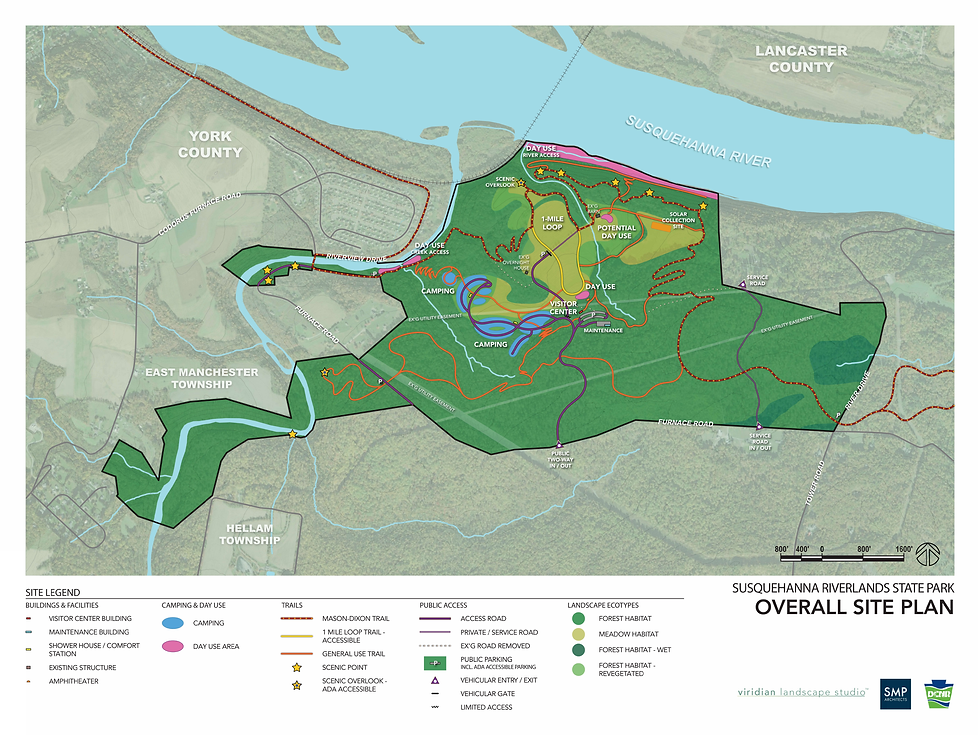
At the largest end of the scale, we incorporated clear loop trails into our master plan for Susquehanna Riverlands State Park. Susquehanna connects internally with loop routes and externally to regional trail networks. In other words: the same basic idea scales from a neighborhood block to an entire landscape system without losing its simplicity.
If mental health is influenced by physical health (and vice versa), then our environments should support both. That means designed landscapes should do more than look good; they should make it easier to feel good—one walk, one loop, one small routine at a time.


